
Bacterial Ribosomes
Recent grant-funded studies in the Agrawal Lab include the structure and function of ribosomes from pathogenic bacteria, including bacteria that cause TB and Lyme disease.
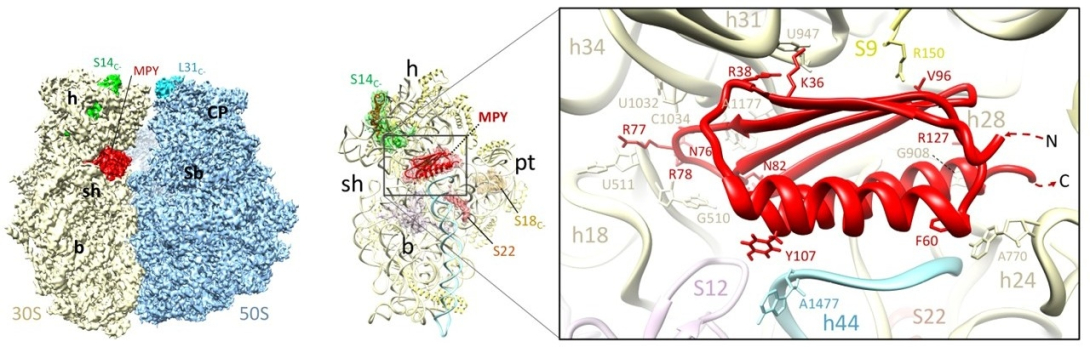
By solving the cryo-EM structures of the C- mycobacterial ribosomes (i.e., remodeled ribosomes under zinc-depleted conditions, where r-proteins with zinc-binding CxxC motif(s) are replaced by r-proteins without a CxxC motif), his lab discovered two novel proteins that bind to promote ribosome hibernation, a key requisite to promote mycobacterial latency in the host cells.
Mpy: The first protein, referred to as Mpy (mycobacterial homolog of protein Y)[1] occupies the mRNA, tRNA, and some of the translation factors binding sites on the ribosome, thereby promoting ribosome hibernation. The presence of Mpy would also prevent the binding of antibiotics that target the decoding center on the small subunit of the ribosome.
RTOF: The discovery of the second protein that we named as Ribosome Tunnel Occlusion Factor (or RTOF)[2] because it was found to occupy the entire nascent-polypeptide exit tunnel (NPET) on the large subunit of the Mycobacterium tuberculosis ribosome isolated from biofilms, such that it would completely block the passage of the nascent polypeptide chain and would also prevent the binding of multiple antibiotics, including linezolid, that target NPET.
Thus, both Mpy and RTOF not only block the process of ribosome-mediated protein synthesis in nutrient-deficient stress conditions, they also prevent the binding of several ribosome-targeting antibiotics, to maintain an antibiotic-free pool of ribosomes during hibernation. Further on-going studies with Mpy and RTOF, in collaboration with the Anil Ojha group, could help in understanding drug tolerance during mycobacterial latency, identifying new drug targets, and developing new drugs to treat mycobacterial infections.
HflX: By solving multiple cryo-EM structures, the Agrawal Lab discovered that the mycobacterial HflX undergoes large conformational changes to mediate antibiotics erythromycin and chloramphenicol resistance[3] and proposed mycobacteria-specific molecular mechanisms that negate the effect of antibiotics[4].
RRF: By determining the cryo-EM structure of the E. coli 70S ribosome in complex with the ribosome-recycling factor (RRF)[5], the Agrawal Lab showed that the L-shaped RRF, which matched a tRNA structure in overall shape and dimension and therefore was previously proposed to have binding configuration similar to that of a tRNAs on the ribosome, instead occupies an obliquely perpendicular orientation to that of previously determined tRNA orientations on the ribosome. Also, his lab was the first to capture both RRF and EF-G on the same 70S ribosome[6].